
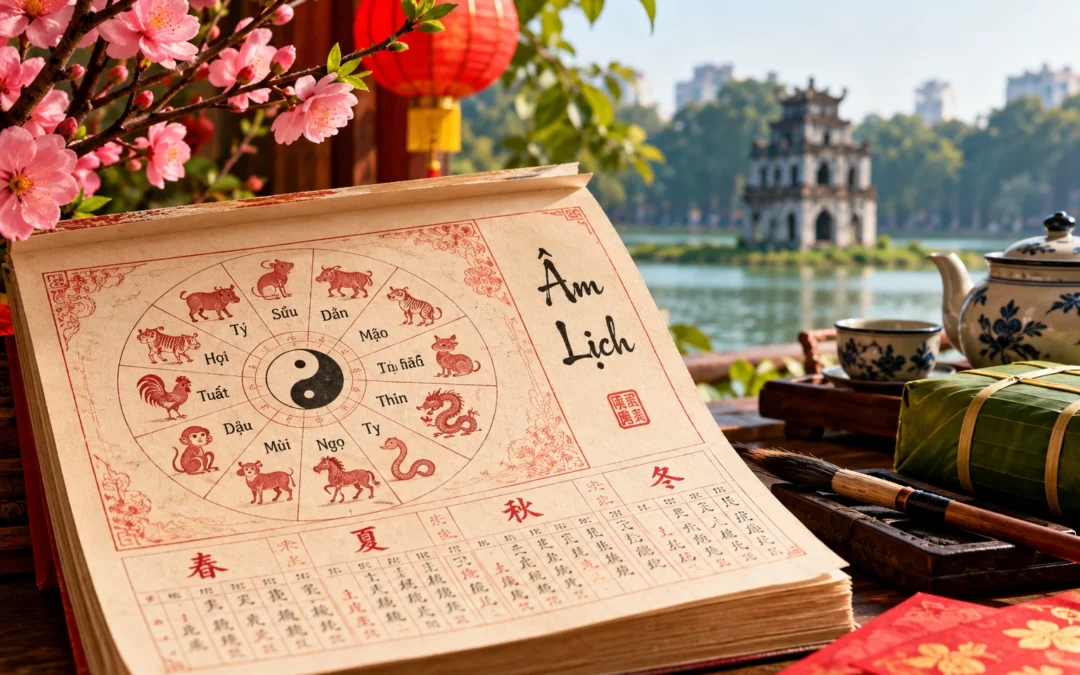
Understanding the Vietnamese Calendar
In Western countries, we use the Gregorian calendar, a solar calendar of Roman origin. In Vietnam, as in China, it is used for official purposes, while the traditional lunisolar calendar continues to shape cultural life. Days and years follow the sun, while months are based on the moon.
A lunar year lasts approximately 354 days, compared with 365 days for a solar year. To keep the two aligned, an extra month (tháng nhuận) is added roughly every two to three years. This intercalary month does not always fall between the third and fourth lunar months.
Major celebrations therefore follow the lunar calendar. Vietnamese New Year, or Tết, begins on the first day of the first lunar month, around the new moon marking the start of the year.
Inspired by the Chinese calendar, the Vietnamese system traditionally uses a cycle of 60 years, combining two smaller cycles. The first consists of 12 Earthly Branches, represented by animals. The second comprises 10 Heavenly Stems, associated with yin and yang and the five elements: wood, fire, earth, metal and water.
Each year is identified by a unique combination of a stem and a branch, giving rise to the familiar zodiac animals: Rat, Ox, Tiger, Cat, Dragon, Snake, Horse, Goat, Monkey, Rooster, Dog and Pig. Unlike the Chinese zodiac, the Vietnamese zodiac features the Cat instead of the Rabbit.
As the 10 stems and 12 branches progress together, their combinations repeat every 60 years. The cycle begins with Giáp Tý and eventually returns to the same pairing, linking each year to a symbolic animal and element.
Discover Vietnam through adventure! Explore the country’s major tourist destinations in a unique, interactive way with our life-size treasure hunts: The Seal of the Emperor in Hanoi, The Strange Case of Dr. Lam in Ho Chi Minh City, and The Malediction of the Jiangshi in Hoi An.
