
Rossio: Lisbon’s Historic Meeting Place
In the heart of Lisbon, Rossio is much more than a busy public square. Officially known as Praça Dom Pedro IV, it has witnessed centuries of commerce, public ceremonies, political change and everyday city life.
A square with a long history
Rossio served as an important public space in medieval Lisbon, hosting markets and gatherings. Over time, it also became associated with religious and political events.
One of its darker historical connections is the Portuguese Inquisition. The Palace of the Estaus, located at the northern end of the square, became the headquarters of the Lisbon Inquisition in the sixteenth century. Public religious proceedings took place at Rossio.
The earthquake of 1755 devastated much of the surrounding area. During the subsequent reconstruction, the square became part of the newly organised downtown district.
Monuments and details
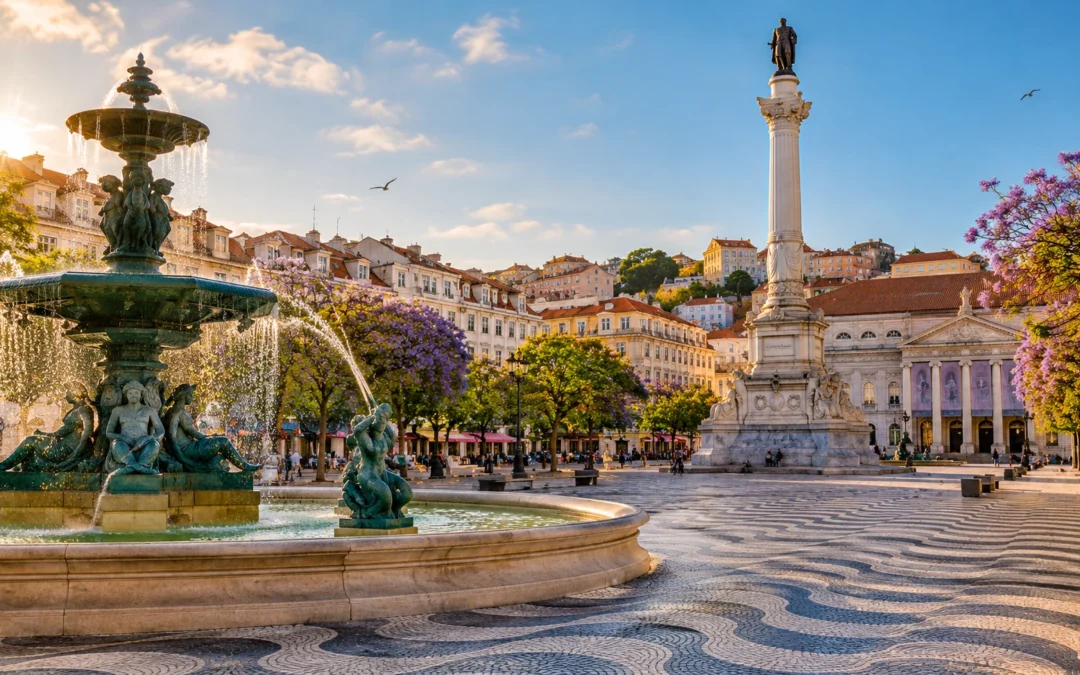
At the centre of Rossio stands a column topped by a statue of King Pedro IV, installed in 1870. Pedro IV was also Pedro I of Brazil and played an important role in the constitutional struggles of the nineteenth century.
At the northern end is the National Theatre D. Maria II, which opened in 1846 on the site of the former Palace of the Estaus.
Look down and you will notice another distinctive feature: the black-and-white Portuguese pavement arranged in flowing wave patterns. This design is among the square’s most recognisable details.
A square that still belongs to Lisbon
Rossio remains a natural meeting point, surrounded by cafés, shops, hotels and busy pedestrian streets. Residents and visitors cross the square throughout the day, continuing its long tradition as a shared public space.
Take a moment to observe the fountains, monuments and pavement. Each tells part of the story, from medieval gatherings to the rebuilding of modern Lisbon.
Rossio is a reminder that history lives not only in museums, but also in the places where a city comes together.
